
Email: douglas.millner@nerxpower.com Location: Houston, TX Hours: 8:00 am – 6:00 pm Central
← All Services

Power Engineering Training

The industry is losing experienced power engineers faster than it can replace them. Training is how you keep institutional knowledge from walking out the door — and how new engineers and technicians become productive on your system sooner.

NERX delivers practical training built by practicing engineers, not professional trainers. A live online course series runs through Fall 2026 — see the schedule below — covering the full arc from symmetrical components through advanced protection and transmission planning. Take the full sequence or join for the subjects your team needs.

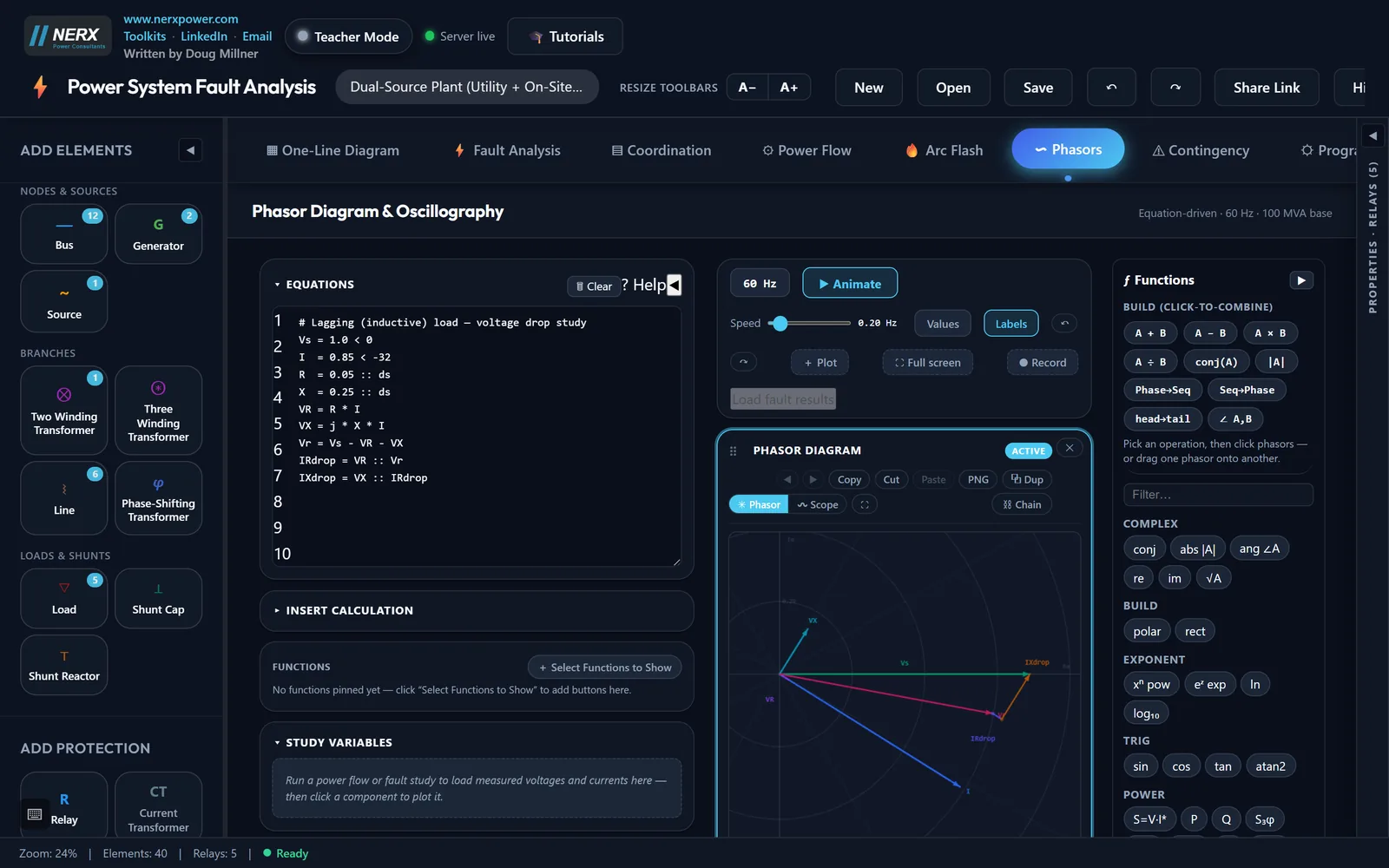
Trainings are taught hands-on using NERX-PFSA (Power System Fault Analysis), a browser-based power flow, fault analysis, relay coordination, and phasor analysis program built by NERX strictly for tutorials and training. Students work live with the instructor on the same cases, in the browser, with nothing to install — and no license needed for commercial fault analysis software such as ETAP, CAPE, PSS/E, SKM, or ASPEN OneLiner.

Beyond the live series, courses can be tailored around your own one-lines, relay settings, and actual event records, so participants leave able to apply what they learned the next day. Sessions are available on-site at your facility or virtually.
Hands-On with NERX-PFSA

Work live with the instructor in NERX-PFSA — browser-based power flow, fault analysis, relay coordination, and phasor analysis built strictly for tutorials and training. Nothing to install, no commercial license required.

Launch NERX-PFSA
fault-analysis-frontend.onrender.com

A power flow solution animating on the dual-source plant sample case.

fault-analysis-frontend.onrender.com
NERX-PFSA phasor diagram and oscillography workspace

Equation-driven phasor diagrams and oscillography.

Live Online Series — Fall 2026 Schedule

Each course runs three parallel tracks — Tuesdays 11:00 AM, Thursdays 12:00 PM, and Saturdays 6:00 AM (Central). Every session is a single ~90-minute meeting at $150 per session, booked individually; two-part courses run as Part 1 and Part 2 on consecutive weeks. Buy a seat and book your dates on the training calendar.

Weeks of Aug 11 & Aug 18

Symmetrical Components

The analytical foundation of protection engineering: per-unit analysis and positive-, negative-, and zero-sequence networks — and how sequence quantities reveal what a fault actually looks like to a relay.

Weeks of Aug 25 & Sep 1

Fault Analysis

Calculating three-phase, line-to-ground, line-to-line, and double-line-to-ground fault currents; building and reducing sequence networks; and applying the results to equipment ratings and relay settings.

Weeks of Sep 8 & Sep 15

Relay Coordination

Time-current coordination from first principles: overcurrent element behavior, time-current characteristic curves, coordination intervals, and coordinating relays with fuses and reclosers across a real system.

Weeks of Sep 22 & Sep 29

Differential Protection

Percentage-restrained and high-impedance differential principles applied to transformers, buses, and generators — slope characteristics, inrush restraint, and CT saturation considerations.

Weeks of Oct 6 & Oct 13

Forensic Event Analysis

Reconstructing events from relay and DFR records: reading oscillography and phasors, interpreting targets, distinguishing correct operations from misoperations, and finding root cause.

Weeks of Oct 20 & Oct 27

Pilot & Communication Schemes

Communication-assisted line protection: permissive overreaching transfer trip, directional comparison blocking, and direct transfer trip schemes, channel considerations, and how scheme logic behaves during real events.

Week of Nov 3

Transfer Schemes & Reclosing

Automatic bus transfer methods, reclosing philosophy and practices, and supervision such as sync-check and voltage blocking.

Week of Nov 10

Arc Flash Analysis & Coordination — Part 1

Incident energy fundamentals and the IEEE 1584 calculation model: data collection, study setup, and the system factors that drive arc flash results.

Week of Nov 17

Arc Flash Analysis & Coordination — Part 2

From study to safer system: the interaction between coordination and incident energy, mitigation options, labeling, and NFPA 70E application.

Weeks of Nov 24 & Dec 1

Transmission Planning

How the planned system is assessed: contingency analysis, thermal and voltage criteria, and the study practices behind NERC TPL compliance.

Have a project to discuss?

Tell us about your system and what you need — we respond promptly.

Email NERX